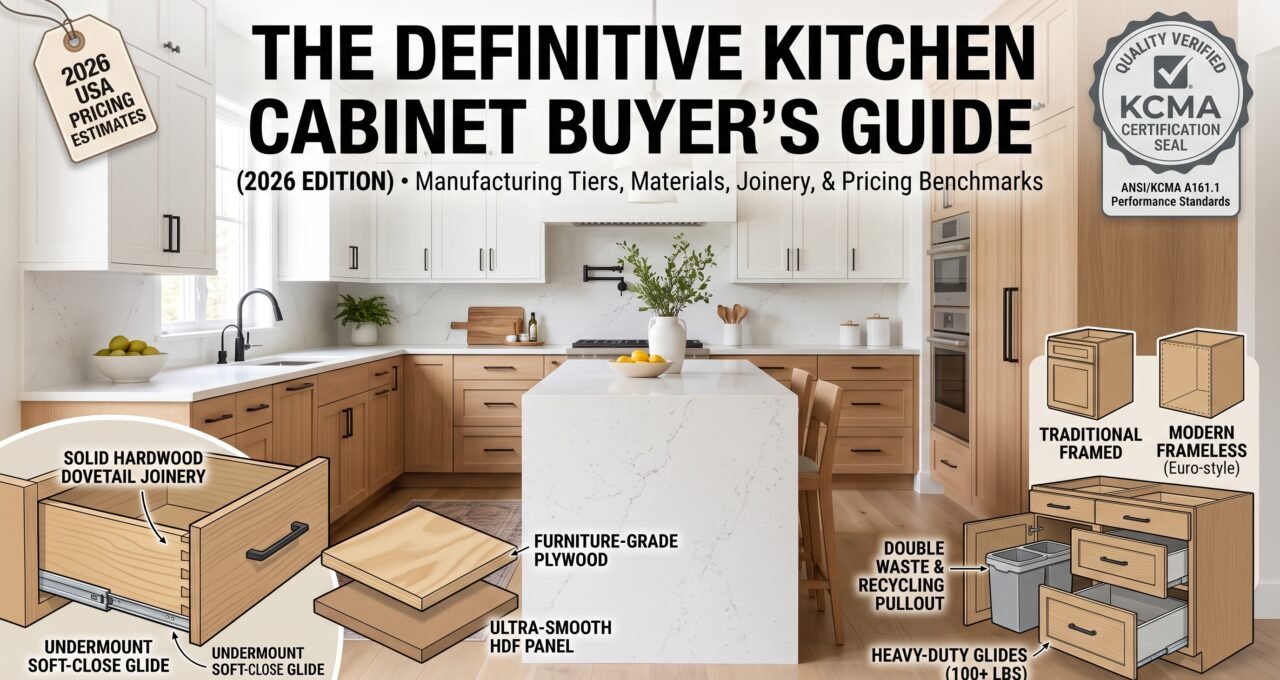
Investing in high-quality kitchen cabinets represents the foundation of any successful culinary renovation. Cabinetry defines the room’s visual architecture, dictates everyday workflow, and typically accounts for 30% to 35% of your total renovation budget. Navigating the residential cabinetry market requires evaluating core structural components, box joinery, finish durability, and certified hardware ratings rather than relying solely on showroom aesthetics.
Whether evaluating modular Ready-to-Assemble (RTA) units for a rental property or commissioning custom kitchen cabinets for a luxury build, this comprehensive buyer’s guide details manufacturing tiers, door profiles, construction materials, 2026 pricing benchmarks, and quality standards for American homeowners.
1. Cabinet Manufacturing Classifications: Stock vs. Semi-Custom vs. Custom
Cabinetry is categorized into three manufacturing tiers. Your choice directly influences design flexibility, lead times, and overall project expenditures.
| Classification | Sizing Increments | Customization Scope | Lead Time | Best Suited For |
| Stock / RTA | Fixed 3-inch increments (e.g., 12″, 15″, 18″) | None to minimal; pre-set catalog finishes | Immediate to 2 weeks | Budget remodels, rental properties, standard galley layouts |
| Semi-Custom | Standard 3-inch increments with custom depth/height mods | Moderate; hundreds of paint/stain finishes, custom pullouts | 4 to 8 weeks | Mid-range renovations, tailored pantry needs, balanced budgets |
| Custom Kitchen Cabinets | Built down to 1/16-inch increments | Unlimited; custom wood species, specialty matching, architectural build-outs | 8 to 16+ weeks | Non-standard ceiling heights, luxury kitchens, complex floor plans |
Stock and Ready-to-Assemble (RTA) Cabinets
Stock cabinets are mass-produced in standardized configurations. RTA options arrive flat-packed to minimize shipping costs and require assembly on-site using cam-lock or wooden dowel fasteners. While cost-effective, stock lines offer limited depth modifications and require filler strips to bridge gaps along irregular drywall.
Semi-Custom Cabinets
Semi-custom cabinetry strikes an ideal balance between price and flexibility. Built to order from established manufacturer platforms, semi-custom lines allow homeowners to increase or decrease box depths, order matching appliance panels, and specify factory-installed interior storage accessories without custom millwork premiums.
Custom Kitchen Cabinets
Custom millwork is built from raw timber and plywood sheets by dedicated cabinet shops or specialized manufacturers. There are no predetermined modular constraints. Custom builds accommodate historical out-of-square walls, arched openings, continuous ceiling-height stacked boxes, and custom wood species like walnut, rift-sawn white oak, and cherry.
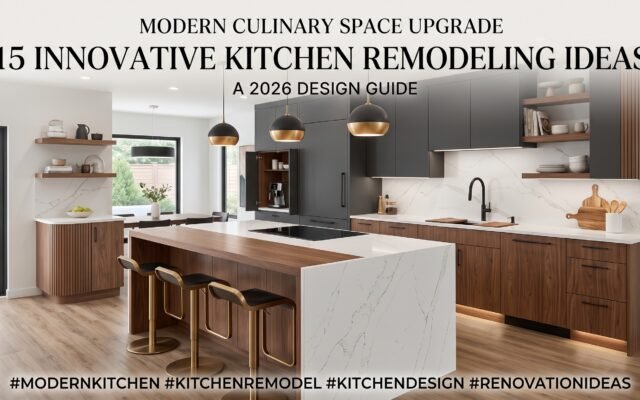
If you are pairing new cabinetry with high-performance surfaces, review our design guide on 15 modern kitchen remodeling ideas for inspiration on waterfall quartz transitions and two-tone aesthetics.
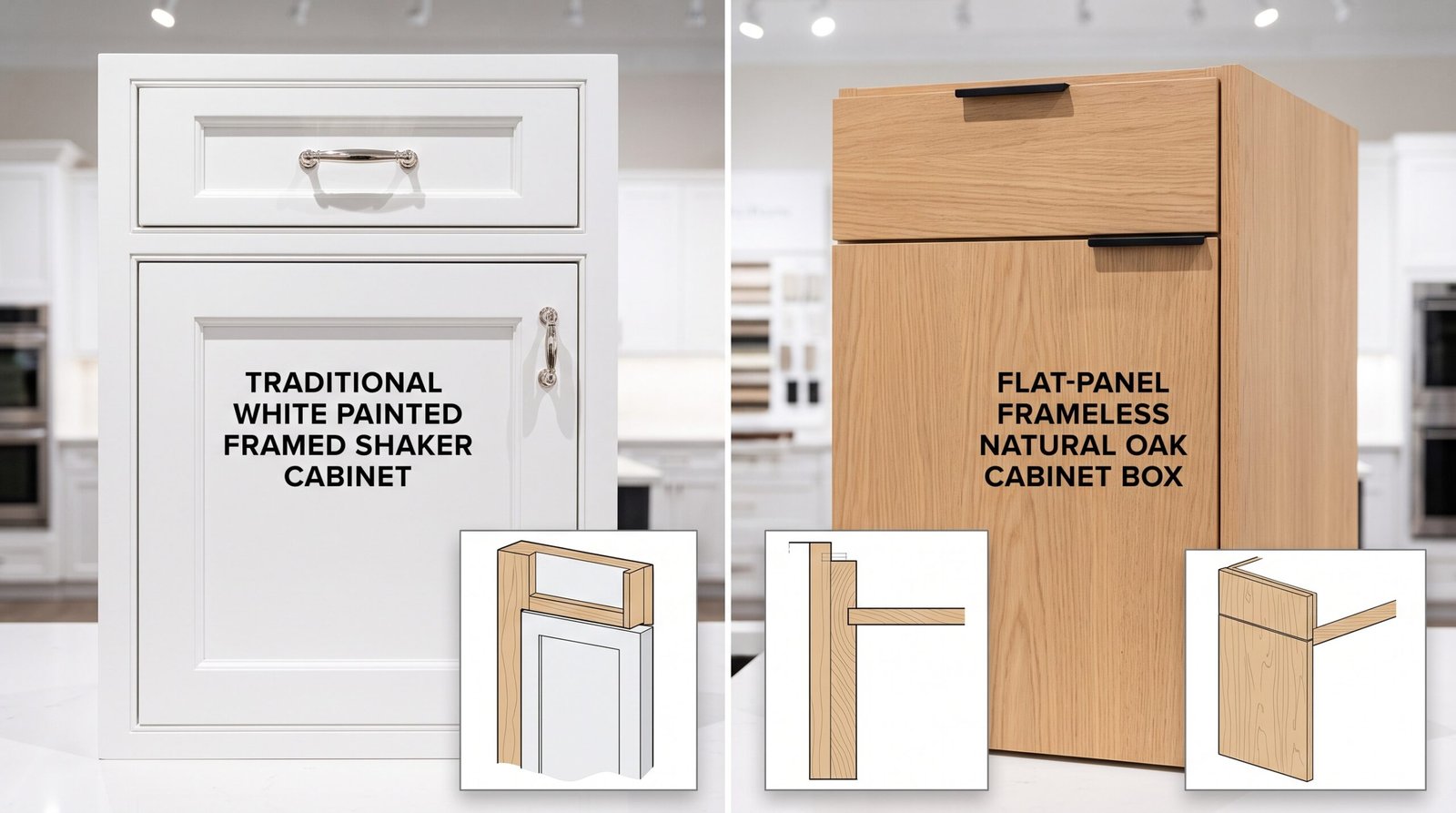
2. Framed vs. Frameless (Euro-Style) Cabinet Construction
American residential construction utilizes two primary structural styles: traditional framed cabinetry and modern frameless (European-style) cabinetry.
       TRADITIONAL FRAMED                        FRAMELESS (EURO-STYLE)
   +------------------------+                  +------------------------+
   |  [Solid Wood Frame]    |                  |  [Raw Box Edge]        |
   |  +------------------+  |                  |  +------------------+  |
   |  |                  |  |                  |  |                  |  |
   |  |   Door Opening   |  |                  |  |   Full Access    |  |
   |  |                  |  |                  |  |   Door Opening   |  |
   |  |                  |  |                  |  |                  |  |
   |  +------------------+  |                  |  +------------------+  |
   +------------------------+                  +------------------------+
   • Structural 1.5" face frame                • Edge-banded 3/4" box walls
   • Traditional American look                 • Maximum internal drawer clearance
Framed Cabinetry (American Standard)
Framed cabinets feature a 1.5-inch solid hardwood face frame attached to the front of the cabinet box. The doors and drawers attach directly to this structural frame using external or concealed hinges. Framed construction offers superior structural rigidity, simplifies installation along uneven plaster or drywall walls, and supports three distinct door overlays:
-
Full Overlay: The door and drawer fronts conceal almost the entire face frame, leaving only a 1/4-inch to 1/8-inch reveal.
-
Partial/Standard Overlay: The door covers only a portion of the frame, exposing 1 to 2 inches of the face frame around each opening.
-
Inset Cabinetry: The door and drawer fronts sit completely flush within the face frame opening, requiring precise craftsmanship and expansion clearances.
Frameless Cabinetry (Full Access / European Style)
Frameless cabinets eliminate the front face frame entirely. The cabinet sides, bottom, and top panels are constructed from thicker 3/4-inch engineered boards, and the doors attach directly to the interior box walls via concealed cup hinges.
-
Expanded Storage Space: Without a face frame extending into the opening, drawer boxes can be built up to 15% wider, and interior pullouts slide in and out with unobstructed clearance.
-
Contemporary Aesthetics: Frameless layouts deliver tight, uniform 1/8-inch reveals between adjacent doors, establishing sleek, minimalist sightlines.
3. Cabinet Box Materials: Plywood vs. MDF vs. Furniture Board
The structural longevity of your kitchen cabinets depends primarily on the core substrate used to fabricate the structural box (carcass).
| Substrate Material | Structural Strength | Moisture Resistance | Screw Holding Power | Relative Cost Index |
| Furniture-Grade Plywood (1/2″ to 3/4″) | Very High | Excellent (minimal swell) | Superior | Premium ($$$$) |
| High-Density Fiberboard (HDF) | High | Moderate (requires sealing) | Very Good | Moderate ($$$) |
| Medium-Density Fiberboard (MDF) | Moderate | Low (swells if exposed) | Moderate | Economical ($$) |
| Engineered Particleboard / Furniture Core | Fair | Poor (vulnerable to water) | Fair | Budget ($) |
Plywood Carcass Construction
Furniture-grade cabinet plywood consists of cross-laminated hardwood plies bonded under intense heat and pressure.
-
Advantages: Exceptionally resilient against deflection over long spans, holds mechanical screws securely under repeated load, and exhibits minimal expansion or contraction during regional humidity shifts.
-
Ideal Application: Base sink cabinets, upper structural boxes, and wide span shelving holding heavy dinnerware.
Medium-Density Fiberboard (MDF) and HDF
MDF and High-Density Fiberboard (HDF) are engineered wood products composed of fine wood fibers combined with resin binders and compressed under extreme density.
-
Advantages: Provides a mirror-smooth, completely grain-free surface that will not expand, warp, or crack along structural joints.
-
Ideal Application: Center recessed panels on painted cabinet doors. Premium cabinetmakers frequently combine solid maple face frames with HDF door panels to prevent hairline paint fractures along expansion joints.
4. Popular Kitchen Cabinet Styles and Door Profiles
Cabinet door profiles establish the architectural identity of your kitchen, bridging traditional charm and modern minimalism.
| Door Style | Profile Characteristics | Best Design Pairing | Maintenance Level |
| Shaker | 5-piece construction with a recessed, unadorned center panel | Transitional, Modern Farmhouse, Coastal | Easy to clean |
| Slab / Flat Panel | Completely smooth, single-piece surface with edge banding | Mid-Century Modern, Minimalist, Contemporary | Easiest (wipe-down) |
| Raised Panel | Elevated center panel featuring decorative bevels and profiles | Traditional, Colonial, European Classical | High (dust settles in grooves) |
| Louvered | Horizontal wood slats set within a perimeter frame | Coastal, Tropical, Cottage | Very High |
| Glass-Front / Mullion | Perimeter wood frame enclosing clear, reeded, or seeded glass | Accent upper cabinets, display zones | Requires interior organization |
    SHAKER PROFILE               SLAB (FLAT) PROFILE          RAISED PANEL PROFILE
+---------------------+         +---------------------+      +---------------------+
| |                 | |         |                     |      | /=================\ |
| |                 | |         |                     |      | |                 | |
| |    Recessed     | |         |      Completely     |      | |     Elevated    | |
| |     Center      | |         |       Uniform       |      | |      Center     | |
| |     Panel       | |         |       Surface       |      | |                 | |
| |                 | |         |                     |      | \=================/ |
+---------------------+         +---------------------+      +---------------------+
The Enduring Dominance of the Shaker Door
The Shaker door remains the most specified cabinet profile in the United States. Its clean lines complement nearly any architectural style. For contemporary variations, designers frequently specify “Skinny Shakers” (micro-shakers), which narrow the outer frame stiles and rails from standard 2.5–3 inches down to 1/2 to 3/4 inches, creating a refined, slender shadow-line.
5. Hardware, Hinges, and Drawer Glide Engineering
A cabinet system is only as durable as its moving mechanical hardware. When evaluating the best kitchen cabinets, prioritize heavy-duty drawer slides and adjustable hinges over decorative handles.
       DRAWER GLIDE COMPARISON
   +-------------------------------------------------------------+
   | SIDE-MOUNT ROLLER RUNNERS                                   |
   | • Visible white epoxy or ball-bearing metal track on side   |
   | • Reduces usable drawer width by 1 inch                     |
   | • Lower weight rating (35–50 lbs)                           |
   +-------------------------------------------------------------+
                                vs.
   +-------------------------------------------------------------+
   | CONCEALED UNDERMOUNT SOFT-CLOSE GLIDES (Blum / Salice)      |
   | • Hidden entirely beneath the solid wood drawer bottom      |
   | • Full extension: reveals 100% of the drawer interior       |
   | • Heavy load ratings (75–100+ lbs dynamic capacity)         |
   | • Integrated fluid dampeners prevent slamming               |
   +-------------------------------------------------------------+
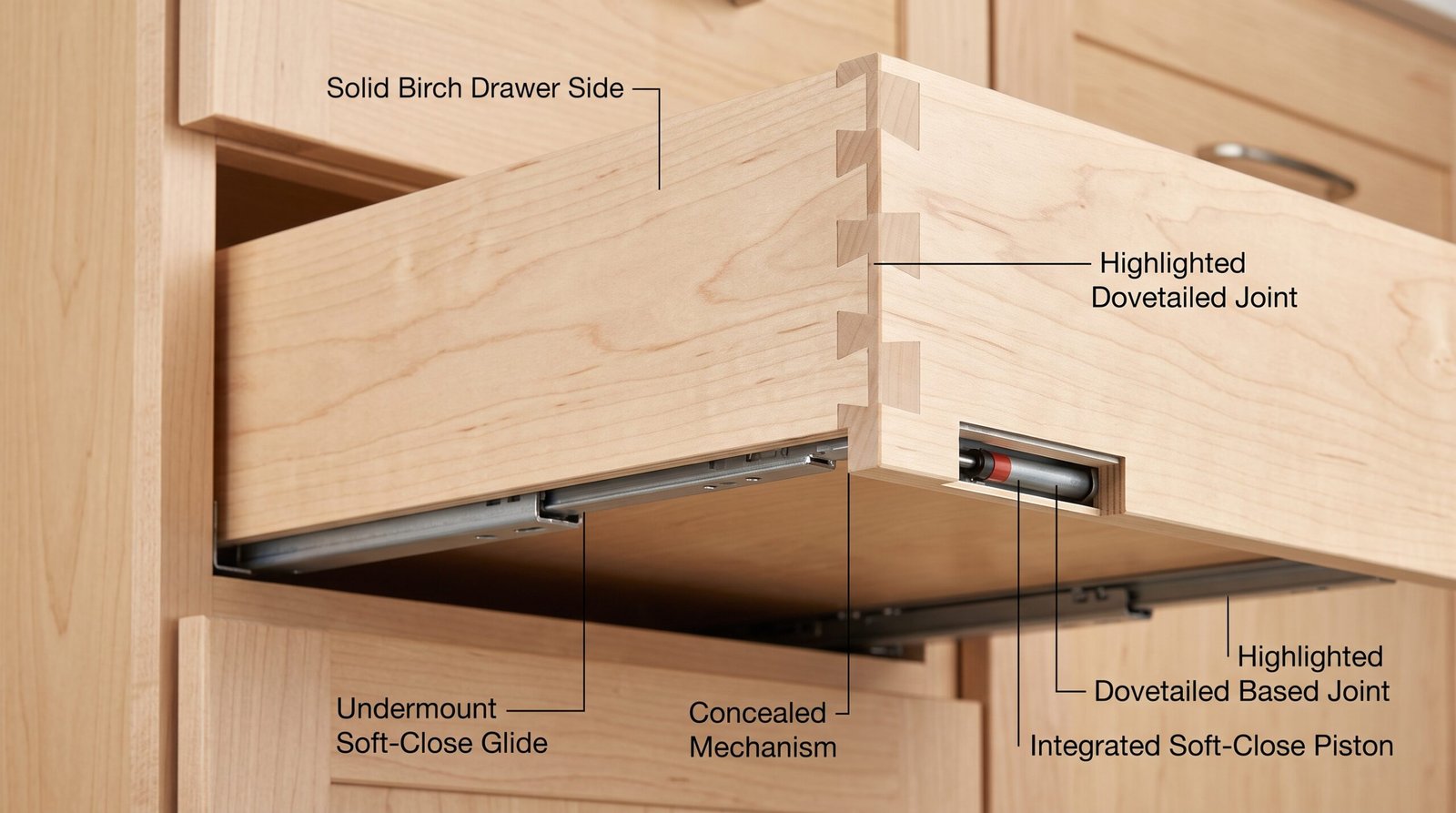
Premium Drawer Box Benchmarks
-
Dovetail Joinery: Interlocking trapezoidal pins and tails joining solid 5/8-inch hardwood drawer sides. Dovetail joints resist outward pulling force far better than pinned, stapled, or doweled joints.
-
Concealed Undermount Glides: Glides positioned beneath the drawer box isolate moving parts from crumbs and cooking grease. Look for recognized hardware brands like Blum (Tandem / Movento), Salice, or Grass.
-
Six-Way Adjustable Hinges: Concealed European cup hinges featuring three-axis mechanical screws (up/down, left/right, in/out) enable precision alignment of door reveals after installation.
6. Factory Applied Finishes vs. Job-Site Painting
The finish applied to your cabinetry determines its resilience against steam, acidic cooking splatters, and abrasive cleaning agents.
| Finish Type | Application Environment | Durability Profile | Maintenance & Touch-Up |
| Factory Baked Conversion Varnish | Controlled factory cleanroom with oven-cure heat | Maximum resistance to chemicals, moisture, chipping | Difficult to blend on-site |
| Factory UV-Cured Urethane | Automated production line cured instantly under UV lamps | Extremely hard, non-yellowing, ultra-smooth | Requires factory touch-up kits |
| Site-Applied Waterborne Enamel | Sprayed or brushed on-site by residential painters | Moderate; susceptible to moisture ingress along joints | Easy to re-coat and touch up |
| High-Pressure Laminate / Acrylic | Vacuum-pressed over MDF under industrial heat | Completely non-porous, highly scratch resistant | Edge-banding may lift under heat |
The Conversion Varnish Standard
Quality cabinet manufacturers finish raw components with post-catalyzed conversion varnish in climate-controlled booths before assembly. The chemical reaction between acid catalysts, amino resins, and thermal baking creates a molecularly cross-linked shield that repels moisture far better than standard architectural wall paints.
7. 2026 Kitchen Cabinet Cost Breakdown: Per Linear Foot & Project Allowances
Cabinetry expenditures are measured in linear feet (measuring the horizontal length of walls receiving cabinetry). Pricing estimates include base cabinets, wall uppers, and tall pantry storage.
Average 2026 USA Cost per Linear Foot
| Tier | Cabinetry Only (Linear Foot) | Professional Labor (Linear Foot) | Total Installed Cost (Linear Foot) |
| Stock / Modular RTA | $70 – $220 | $45 – $90 | $115 – $310 |
| Semi-Custom Standard | $220 – $550 | $65 – $140 | $285 – $690 |
| Custom Architectural Millwork | $550 – $1,250+ | $120 – $250+ | $670 – $1,500+ |
Estimating Total Kitchen Layouts
-
Small Galley Kitchen (15–20 Linear Feet):
-
Stock: $2,000 – $4,500
-
Semi-Custom: $4,500 – $10,500
-
Custom: $11,000 – $22,000+
-
-
Medium L-Shaped Kitchen (20–35 Linear Feet):
-
Stock: $3,500 – $7,500
-
Semi-Custom: $7,500 – $18,000
-
Custom: $18,000 – $38,000+
-
-
Large Open-Concept Kitchen with Island (35–50+ Linear Feet):
-
Stock: $5,500 – $12,000
-
Semi-Custom: $12,000 – $28,000
-
Custom: $28,000 – $65,000+
-
For a comprehensive breakdown of trade labor rates, plumbing relocation costs, and permitting allowances across all renovation phases, consult our line-item guide on the kitchen remodel cost in 2026 and explore square-footage planning metrics in our guide to understanding kitchen remodel costs in 2026. also read this.
8. Quality Verification: KCMA Certification Benchmarks
To protect against inferior manufacturing, verify whether your prospective cabinet line carries the KCMA (Kitchen Cabinet Manufacturers Association) Quality Seal.
Compliant cabinets undergo rigorous laboratory performance testing under ANSI/KCMA A161.1 protocols:
-
Weight Bearing Capacity: Wall cabinets are loaded to 600 pounds without showing joint separation or deflection along hanging rails.
-
Door Durability: Cabinet doors withstand 25,000 continuous opening and closing cycles and a 65-pound downward static weight load without hinge sag.
-
Drawer Slide Cycles: Drawer systems survive 25,000 cycles fully loaded to 15 pounds per square foot.
-
Moisture & Stain Exposure: Finishes are continuously exposed to boiling water, high-humidity condensation, and staining agents (mustard, vinegar, citrus juice, coffee) for 24 hours without blistering or discoloring.
+--------------------------------------------------------------------------+
|                        CABINET QUALITY CHECKLIST                         |
+--------------------------------------------------------------------------+
|  [ ] Box Sides: Minimum 1/2" to 3/4" Grade-A Plywood or Dense HDF        |
|  [ ] Back Panel: Full 1/2" hanging rail capture (not stapled 1/8" board) |
|  [ ] Shelves: 3/4" thickness to eliminate center bowing under dish loads |
|  [ ] Drawer Joinery: Solid wood 5/8" sides with machined dovetail joints |
|  [ ] Glides: Undermount full-extension soft-close rated for 75+ lbs      |
|  [ ] Hinges: 6-way adjustable concealed cup hinges with soft-close       |
|  [ ] Finish: Industrial conversion varnish or UV-cured factory topcoat   |
|  [ ] Standards: Valid ANSI/KCMA A161.1 performance seal displayed       |
+--------------------------------------------------------------------------+
9. Smart Interior Storage Solutions and Ergonomics
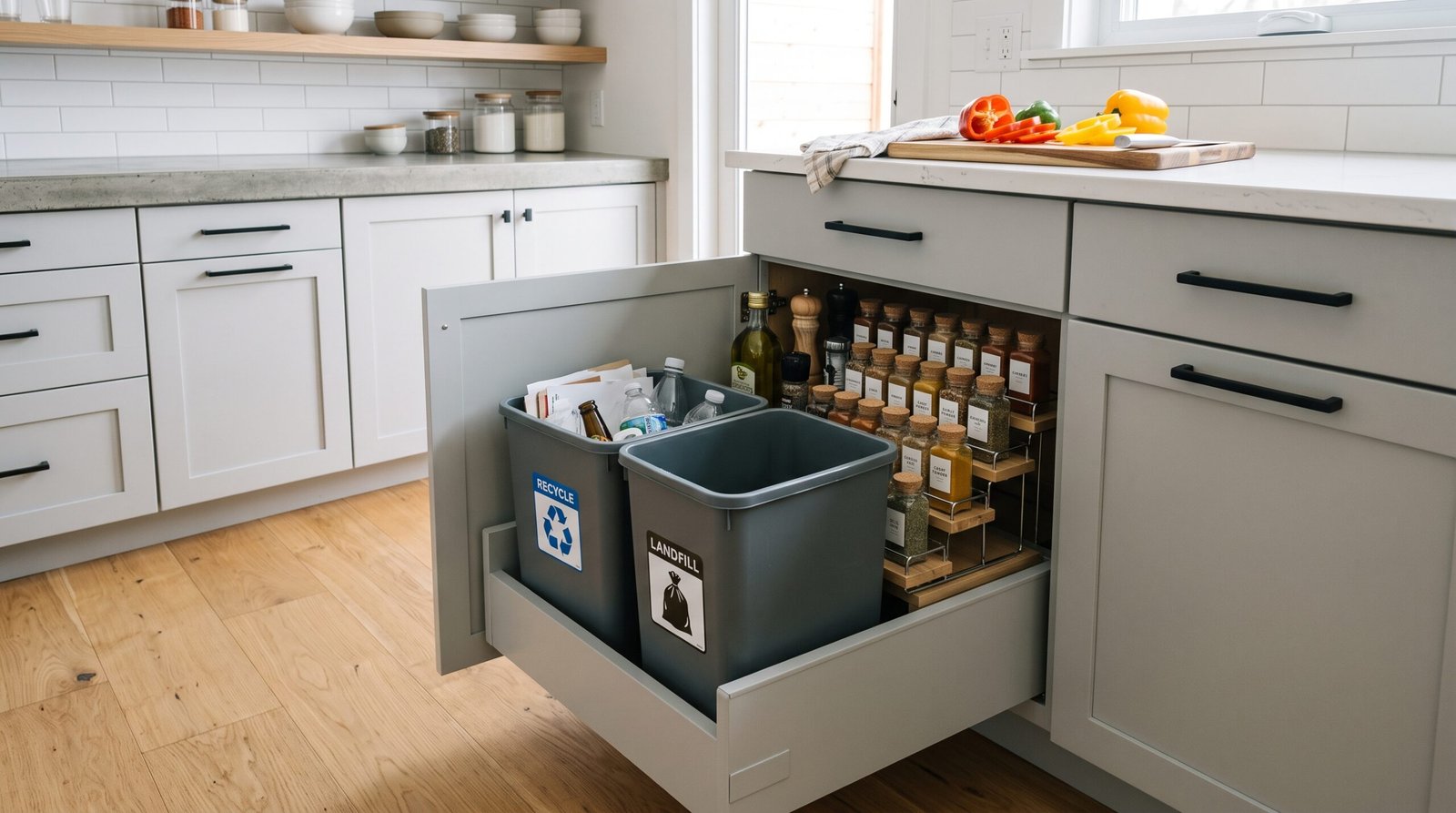
Maximizing usable cabinet storage requires prioritizing dynamic interior accessories over passive shelving. Modern kitchen efficiency relies on keeping countertops clear by allocating dedicated interior zones for daily tasks.
-
Double Waste & Recycling Pullouts: Positioned next to the primary cleanup sink to streamline food preparation and scrape plates directly into bins.
-
Deep Pot-and-Pan Drawers: Replacing lower shelving with 12-to-14-inch-deep drawers equipped with heavy-duty 100-pound slides allows heavy Dutch ovens and stockpots to be reached without kneeling.
-
Blind Corner Pullout Trays (LeMans Shelves): Articulating kidney-shaped shelves pull completely outward from deep corner voids, reclaiming otherwise wasted square footage.
-
Vertical Tray Dividers: Slender 9-to-12-inch base cabinets provide organized vertical storage for baking sheets, cutting boards, and cooling racks.
-
Appliance Garages with Interior Outlets: Counter-level tambour or bi-fold pocket cabinets conceal blenders, toasters, and stand mixers while keeping them plugged in and ready for operation.
Frequently Asked Questions
Which type of kitchen cabinet box material lasts the longest?
Furniture-grade 3/4-inch plywood is widely recognized as the longest-lasting box substrate. It provides exceptional tensile strength, holds heavy stone countertops without sagging, and resists moisture-induced swelling far better than low-density particleboard.
Are painted cabinets more expensive than stained wood cabinets?
Yes. Factory-painted cabinets typically command a 10% to 15% price premium over stained wood. Achieving a smooth painted finish requires higher-grade surface prep, fine-sanded HDF or tight-grain maple, multiple primer layers, and specialized cleanroom spray environments to prevent dust contamination.
Is refacing existing cabinets worth it compared to total replacement?
Cabinet refacing (replacing door/drawer fronts and applying matching veneer to existing boxes) makes economic sense if your structural carcasses are made of sound plywood and you are satisfied with your existing kitchen footprint. Refacing typically saves 30% to 45% compared to purchasing new semi-custom cabinets. However, if your layout requires moving appliances or the existing boxes are degraded, a complete replacement yields superior long-term value.
Final Purchasing Takeaways
Selecting the right kitchen cabinets requires balancing your financial budget with structural engineering. Prioritizing 3/4-inch plywood or high-density engineered carcasses, dovetailed drawer joinery, undermount soft-close glides, and factory-baked conversion varnish protects your kitchen from early mechanical fatigue and ensures high resale value across decades of culinary use.

💬 1 Thought on “Kitchen Cabinets: A Complete Buyer’s Guide for USA Homeowners (2026)”